


OCD is often misunderstood. Many people picture handwashing, checking locks, or arranging items in a perfect order. Those symptoms can happen, but OCD can also stay hidden inside the mind.
Some adults have painful intrusive thoughts, silent rituals, repeated reassurance seeking, or fears they feel too ashamed to share. Because these symptoms are less visible, people may blame themselves instead of recognizing OCD.
OCD is not a personality flaw or a lack of willpower. It is a treatable mental health condition. With the right support, adults can reduce symptoms, regain confidence, and feel less controlled by fear.
Understanding Hidden OCD Symptoms
OCD involves two main parts: obsessions and compulsions. Obsessions are unwanted thoughts, images, or urges that cause distress. Compulsions are actions or mental rituals used to reduce fear.
The International OCD Foundation explains that obsessions are unwanted intrusive thoughts, images, or urges, while compulsions are behaviors used to reduce distress or get rid of obsessions.
Hidden OCD can be hard to spot because compulsions may happen silently. A person may look calm on the outside while repeating phrases, reviewing memories, or testing feelings inside their mind.
| OCD Feature | What It Can Look Like |
| Obsessions | Unwanted thoughts, images, fears, or doubts |
| Compulsions | Checking, repeating, researching, confessing, or mental reviewing |
| Avoidance | Staying away from triggers, people, places, or decisions |
| Reassurance seeking | Asking others for certainty again and again |
| Distress | Shame, fear, guilt, anxiety, or mental exhaustion |
OCD affects real life for many adults. The National Institute of Mental Health reports that about 1.2% of U.S. adults had OCD in the past year, and 2.3% experience OCD during their lifetime.
5 Hidden Types of OCD Adults Often Miss
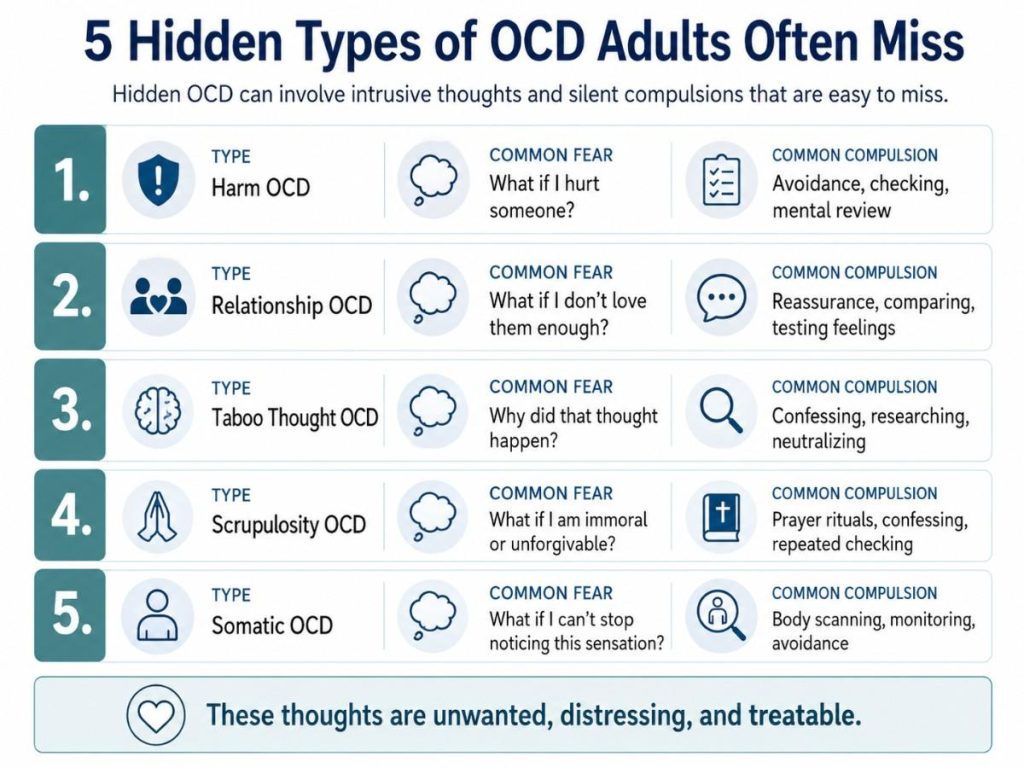
Hidden OCD themes can feel deeply personal. The thoughts may seem shocking, confusing, or opposite to a person’s values. That is one reason many adults suffer quietly.
The content of the thought does not define the person. In OCD, the distress often comes from how unwanted and “sticky” the thought feels.
| Hidden Type of OCD | Common Fear | Common Compulsion |
| Harm OCD | “What if I hurt someone?” | Avoidance, checking, mental review |
| Relationship OCD | “What if I do not love them enough?” | Reassurance, comparing, testing feelings |
| Taboo Thought OCD | “Why did that thought happen?” | Confessing, researching, neutralizing |
| Scrupulosity OCD | “What if I am immoral or unforgivable?” | Prayer rituals, confessing, repeated checking |
| Somatic OCD | “What if I can’t stop noticing this sensation?” | Body scanning, monitoring, avoidance |
1. Harm OCD
Harm OCD involves unwanted fears about hurting yourself or others. These thoughts can feel terrifying because they go against your values.
Adults with harm OCD may avoid knives, driving, being near loved ones, or caring for children. They may also replay events to prove nothing bad happened.
Common signs include:
- Fear of losing control
- Avoiding people or objects
- Repeatedly checking for harm
- Asking others for reassurance
- Reviewing memories for “proof”
These thoughts are not the same as intent. Many people with harm OCD are deeply caring and distressed because the thoughts feel so wrong.
2. Relationship OCD
Relationship OCD causes repeated doubts about love, attraction, compatibility, or commitment. The person may care deeply about their partner but feel trapped in constant questioning.
This type can affect dating, marriage, friendships, or family relationships. It may create guilt, distance, or repeated conversations that never bring lasting certainty.
Common signs include:
- Comparing your relationship to others
- Checking feelings throughout the day
- Asking if the relationship is “right”
- Searching online for answers
- Feeling relief, then doubting again
Adults needing deeper care for intrusive doubts may benefit from personalized OCD care that addresses both symptoms and daily functioning.
3. Taboo Thought OCD
Taboo thought OCD involves unwanted thoughts about topics that feel shameful, shocking, or unacceptable. These may involve harm, sexuality, religion, identity, or morality.
The thoughts can feel so distressing that people hide them for years. They may fear being judged, misunderstood, or seen as dangerous.
Common signs include:
- Fear that a thought means something about you
- Repeatedly checking your reactions
- Confessing thoughts to feel safe
- Avoiding certain media or situations
- Searching for certainty online
The problem is not the presence of a strange thought. The problem is the OCD cycle that treats the thought as urgent, meaningful, or dangerous.
4. Scrupulosity OCD
Scrupulosity OCD centers on religious, moral, or ethical fears. A person may fear offending God, breaking a rule, lying, being impure, or making the wrong choice.
This type can affect people with or without religious beliefs. It often targets what matters most to the person, including honesty, kindness, faith, or responsibility.
Common signs include:
- Repeating prayers until they feel “right”
- Confessing small mistakes again and again
- Seeking moral reassurance
- Avoiding decisions from fear of wrongdoing
- Reviewing conversations for possible harm
Scrupulosity can be especially painful because it can make personal values feel unsafe. Treatment helps people separate healthy values from OCD-driven fear.
5. Somatic OCD
Somatic OCD involves intense focus on body sensations or automatic processes. A person may become stuck noticing breathing, blinking, swallowing, heartbeat, or visual patterns.
The fear is often not the sensation itself. The fear is that awareness will never stop, or that life will always feel distracted and uncomfortable.
Common signs include:
- Constantly checking body sensations
- Trying to force attention away
- Avoiding quiet places
- Searching for ways to stop awareness
- Feeling trapped by normal body functions
Somatic OCD can improve when treatment helps reduce monitoring and fear. The goal is not to force thoughts away, but to change the response to them.
How Hidden OCD Can Affect Daily Life

Hidden OCD can take time, energy, and confidence from daily life. It may affect work, relationships, sleep, parenting, school, faith, or decision-making.
https://www.nimh.nih.gov/health/statistics/obsessive-compulsive-disorder-ocd NIMH reports that among U.S. adults with OCD, about 50.6% experience serious impairment. That means OCD can create major disruption, even when symptoms are not obvious to others.
| Life Area | Possible Impact |
| Work | Trouble focusing, repeated checking, fear of mistakes |
| Relationships | Reassurance cycles, guilt, emotional distance |
| Sleep | Racing thoughts, review rituals, bedtime anxiety |
| Faith or values | Fear of moral failure, repeated confessing |
| Health | Body checking, scanning, fear of sensations |
| Daily choices | Avoidance, indecision, repeated research |
Some adults do not seek help because they believe their thoughts are too strange to discuss. Others may think they should be able to stop the thoughts on their own.
Support may be needed when symptoms take more than an hour per day, cause distress, or interfere with normal life. These are common reasons adults seek psychiatric support for clearer evaluation and treatment.
Available Treatments for Hidden OCD
Hidden OCD is treatable. The most effective care usually focuses on reducing compulsions, building tolerance for uncertainty, and changing the fear response.
Exposure and Response Prevention, often called ERP, is a form of therapy designed for OCD. ERP helps people face triggers without doing the ritual that keeps OCD active.
NICE recommends CBT that includes ERP for adults with OCD, and it recommends combined SSRI medication and CBT with ERP for adults with severe functional impairment.
| Treatment Option | How It Helps | Often Used For |
| ERP therapy | Helps face fears without compulsions | Most OCD types |
| CBT skills | Helps change unhelpful thought patterns | Anxiety and OCD-related beliefs |
| SSRIs | May reduce obsession intensity and anxiety | Moderate to severe symptoms |
| Medication management | Tracks dose, side effects, and progress | Adults needing structured support |
| Combined care | Uses therapy and medication together | More impairing OCD symptoms |
Medication may be helpful when OCD symptoms feel intense, constant, or hard to manage with therapy alone. A psychiatric provider can review whether medication is appropriate.
Adults comparing treatment options may find that ERP and medication work best when they support the same recovery goals.
Treatment may also include anxiety support when panic, sleep problems, or constant worry appear alongside OCD. A provider can review whether anxiety medication fits the full symptom picture.
When to Seek Professional Help
You do not need to wait until OCD becomes severe. Early care can help prevent symptoms from taking more space in your life.
Consider support if you notice:
- Intrusive thoughts feel hard to dismiss
- You avoid important people, places, or tasks
- Reassurance only helps for a short time
- Mental rituals take up your day
- Shame keeps you from talking openly
- Symptoms affect work, sleep, or relationships
- You feel stuck in repeated doubt
A complete evaluation can also check for anxiety, depression, trauma, or other concerns. Many adults benefit from care that looks at the full picture of adult mental health, not just one symptom.
How MD Psych Clinic Supports Your OCD Medication Journey

At MD Psych Clinic, our board-certified psychiatrists specialize in personalized medication management for adults with OCD. We combine evidence-based prescribing with compassionate, ongoing support to help you find the right medication, dose, and timeline for lasting relief.
Our team helps adults understand symptoms, review treatment options, and build a plan that fits daily life. Care may include medication management, therapy coordination, and ongoing follow-up.
Adults seeking OCD treatment can receive structured support for intrusive thoughts, compulsions, avoidance, and related anxiety symptoms.
What we offer:
- Comprehensive OCD evaluation and medication planning
- Careful SSRI titration with side-effect monitoring
- Coordination with therapists for ERP and medication synergy
- Flexible follow-ups, in person or by telehealth, for Georgia patients
For local care, MD Psych Clinic also provides Alpharetta OCD support for adults who need compassionate treatment planning close to home.
Ready to optimize your OCD treatment?
Call 770-680-2302 or Schedule a Consultation to speak with our team today.
Email: patient@mdpsychclinic.com
Hours: Monday–Friday, 8:00 AM – 5:00 PM
Location: 3235 North Point Parkway, Suite 203, Alpharetta, GA 30005
You do not have to manage OCD alone. Let’s build a plan that works for you.
Frequently Asked Questions
What are the hidden types of OCD adults often miss?
Hidden OCD can include harm OCD, relationship OCD, taboo thought OCD, scrupulosity OCD, and somatic OCD. These symptoms may not look obvious because many rituals happen mentally, such as reviewing, checking feelings, praying repeatedly, or seeking certainty.
How do I know if my intrusive thoughts are OCD?
Intrusive thoughts may be OCD when they feel repetitive, distressing, and hard to dismiss. OCD often includes compulsions, such as reassurance seeking, avoidance, checking, researching, or mental reviewing to feel safe.
Can hidden OCD get worse without treatment?
Yes, OCD can become more disruptive when compulsions and avoidance grow over time. Treatment can help reduce the cycle of fear, rituals, and short-term relief that keeps OCD active.
What treatment does MD Psych Clinic offer for OCD?
MD Psych Clinic offers OCD evaluation, personalized medication management, SSRI monitoring, and coordination with therapists for ERP support. Care is designed for adults who need structured, compassionate psychiatric support.
Does MD Psych Clinic offer telehealth for OCD treatment in Georgia?
Yes. MD Psych Clinic offers flexible follow-ups, including telehealth options for Georgia patients. Adults can receive medication support, symptom monitoring, and ongoing care without managing OCD alone.