


A panic attack can feel sudden, intense, and frightening. Your heart may race, your chest may tighten, and your thoughts may tell you something is wrong.
Even when the symptoms feel overwhelming, a panic attack usually passes. The goal is not to fight every sensation. The goal is to steady your body, slow the fear cycle, and remind yourself that this moment is temporary.
Panic symptoms are more common than many people realize. NIMH reports that 2.7% of U.S. adults had panic disorder in the past year, and 4.7% experience it at some point in life.
What a Panic Attack Can Feel Like
A panic attack is a sudden wave of intense fear or discomfort. It can include a racing heart, sweating, trembling, shortness of breath, dizziness, nausea, chest pain, or tingling.
Many people feel afraid they are losing control or having a medical emergency. This fear can make symptoms feel stronger, even when the body is not in danger.
| Panic Symptom | What It May Feel Like |
| Racing heart | Your heart feels fast, loud, or pounding |
| Shortness of breath | You feel like you cannot get enough air |
| Chest tightness | Pressure, discomfort, or tension in the chest |
| Dizziness | Lightheaded, shaky, or unsteady |
| Tingling | Numbness or pins-and-needles in hands or face |
| Fear of dying | A strong sense that something terrible is happening |
Panic attacks can feel similar to heart symptoms. If chest pain is new, severe, lasts, spreads, or feels different than usual, seek urgent medical care. Mayo Clinic notes it can be hard to tell the difference between a panic attack and a heart attack.
A Simple Checklist for the First 10 Minutes
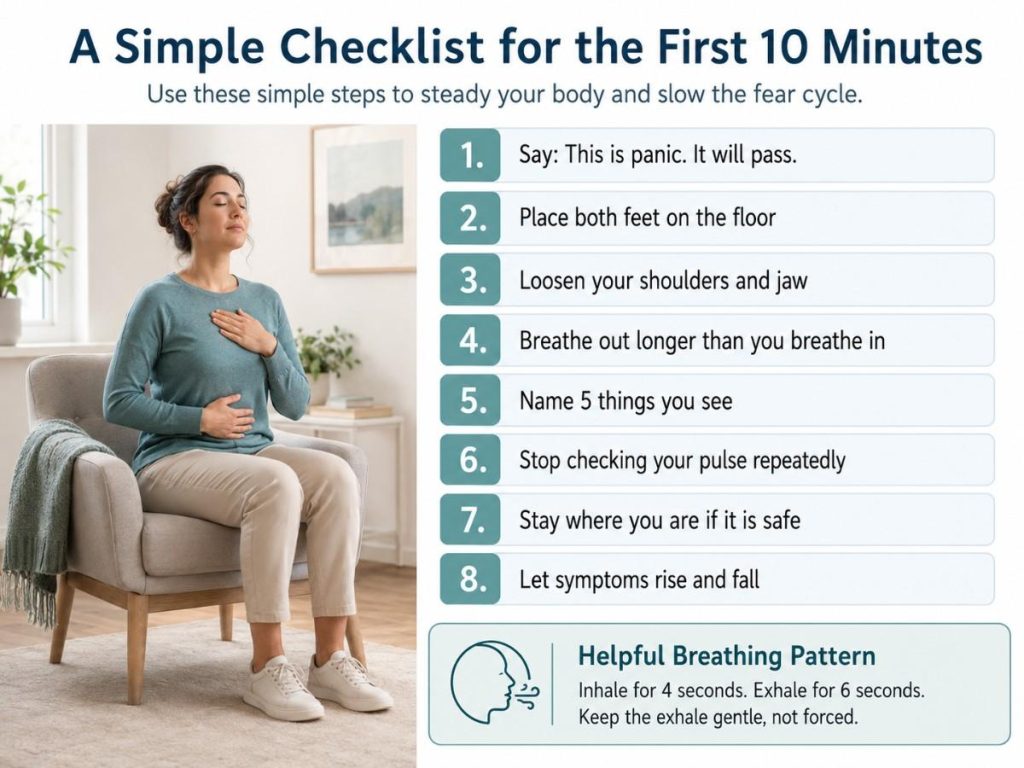
When panic rises, your brain may push you to escape, check symptoms, or search for reassurance. A checklist gives your mind one clear job.
Use the steps below slowly. You do not have to do them perfectly. You only need to stay with the moment long enough for the wave to pass.
| Step | What to Do | Why It Helps |
| 1 | Say, “This is panic. It will pass.” | Labels the experience clearly |
| 2 | Place both feet on the floor | Helps your body feel grounded |
| 3 | Loosen your shoulders and jaw | Reduces tension signals |
| 4 | Breathe out longer than you breathe in | Slows the fear response |
| 5 | Name five things you see | Brings attention back to the room |
| 6 | Stop checking your pulse repeatedly | Reduces fear-focused monitoring |
| 7 | Stay where you are if it is safe | Teaches your brain you can cope |
| 8 | Let symptoms rise and fall | Reduces the urge to fight panic |
A practical breathing pattern can help. Try breathing in for four seconds, then breathing out for six seconds. Keep the exhale gentle, not forced.
Grounding can also help when thoughts feel fast. Name five things you see, four things you feel, three things you hear, two things you smell, and one thing you taste.
If panic attacks happen often, structured panic attack care can help you understand triggers, reduce fear of symptoms, and build a treatment plan.
What to Do After the Panic Attack Passes
Many people feel tired after a panic attack. Your body has been on high alert, so it may need time to settle.
Try not to judge yourself afterward. Panic attacks are not weakness. They are intense fear responses that can improve with the right support.
| After the Attack | Helpful Action |
| First 10 minutes after | Drink water and sit somewhere calm |
| Same day | Eat something light if your stomach allows |
| Later that day | Write down what happened before symptoms began |
| That night | Keep your routine as steady as possible |
| Next day | Return to normal activities in small steps |
A short note can help you spot patterns. Write down where you were, what you felt, what you feared, and what helped.
Sleep also matters. Anxiety and poor sleep can feed each other, so support for sleep and anxiety may help reduce future episodes.
When Panic Attacks Need Professional Support

One panic attack does not always mean you have panic disorder. Professional support becomes more important when attacks repeat, feel unpredictable, or cause avoidance.
NIMH reports that 44.8% of adults with panic disorder have serious impairment. This means panic symptoms can strongly affect work, relationships, routines, and quality of life.
Consider getting help if you notice:
- You worry often about having another panic attack
- You avoid driving, stores, crowds, work, or social plans
- You repeatedly check your pulse, breathing, or blood pressure
- You visit urgent care often because symptoms feel dangerous
- You rely on alcohol, sedatives, or avoidance to cope
- You feel embarrassed, trapped, or limited by panic symptoms
| Pattern | What It May Mean |
| Panic happens repeatedly | You may need a full anxiety evaluation |
| You avoid normal places | Panic may be shrinking your daily life |
| You fear body sensations | Treatment can help reduce symptom fear |
| You cannot sleep well | Anxiety may be keeping your body activated |
| You feel stuck despite coping skills | Medication or therapy may help |
Adults who struggle with repeated fear, worry, or avoidance may also benefit from broader anxiety treatment that looks at the full pattern, not just one episode.
Treatment Options That Can Help
Panic attacks are treatable. Mayo Clinic notes that psychotherapy, medication, or both may help reduce panic attack frequency and improve daily function.
Cognitive behavioral therapy can help you understand panic symptoms and respond to them differently. MedlinePlus notes that CBT can teach people how to cope with panic attacks and function better in daily life.
Medication may also help when panic attacks are frequent, severe, or tied to ongoing anxiety. A psychiatrist can review symptoms, medical history, side effects, and goals before recommending options.
| Treatment Option | How It Helps | Best For |
| CBT | Changes fear-based thought and behavior patterns | Panic attacks with avoidance |
| Breathing practice | Helps calm the body during symptoms | Mild to moderate panic symptoms |
| Medication | May reduce attack frequency and anxiety intensity | Frequent or severe panic |
| Sleep support | Reduces stress on the nervous system | Panic linked with poor sleep |
| Telepsychiatry | Makes follow-up care easier to access | Busy adults or Georgia patients |
Some adults benefit from anxiety medication support when panic symptoms keep returning despite coping skills and lifestyle changes.
For many Georgia patients, telepsychiatry visits make it easier to stay consistent with care, especially when anxiety makes travel difficult.
How MD Psych Clinic Supports Panic Attack Recovery

At MD Psych Clinic, our board-certified psychiatrists support adults who are dealing with panic attacks, anxiety, and related symptoms. We combine careful evaluation, evidence-based treatment, and compassionate follow-up care.
Our goal is to help you understand what is happening, reduce fear of symptoms, and build a plan that fits your life. Treatment may include medication management, therapy coordination, lifestyle support, and regular progress checks.
What we offer:
- Comprehensive anxiety and panic attack evaluation
- Personalized medication planning when appropriate
- Careful dose adjustments with side-effect monitoring
- Coordination with therapists when CBT support is needed
- Flexible follow-ups, in person or by telehealth, for Georgia patients
Scheduling care can feel easier when the next step is clear. Many adults start with an online anxiety appointment and then build a plan with a psychiatric provider.
Ready to feel more steady and supported?
Call 770-680-2302 or Schedule a Consultation to speak with our team today.
Email: patient@mdpsychclinic.com
Hours: Monday–Friday, 8:00 AM – 5:00 PM
Location: 3235 North Point Parkway, Suite 203, Alpharetta, GA 30005
You do not have to manage panic attacks alone. Let’s build a plan that helps you feel safer, calmer, and more in control.
Frequently Asked Questions
What are the hidden types of OCD adults often miss?
Hidden OCD can include harm OCD, relationship OCD, taboo thought OCD, scrupulosity OCD, and somatic OCD. These symptoms may not look obvious because many rituals happen mentally, such as reviewing, checking feelings, praying repeatedly, or seeking certainty.
How do I know if my intrusive thoughts are OCD?
Intrusive thoughts may be OCD when they feel repetitive, distressing, and hard to dismiss. OCD often includes compulsions, such as reassurance seeking, avoidance, checking, researching, or mental reviewing to feel safe.
Can hidden OCD get worse without treatment?
Yes, OCD can become more disruptive when compulsions and avoidance grow over time. Treatment can help reduce the cycle of fear, rituals, and short-term relief that keeps OCD active.
What treatment does MD Psych Clinic offer for OCD?
MD Psych Clinic offers OCD evaluation, personalized medication management, SSRI monitoring, and coordination with therapists for ERP support. Care is designed for adults who need structured, compassionate psychiatric support.
Does MD Psych Clinic offer telehealth for OCD treatment in Georgia?
Yes. MD Psych Clinic offers flexible follow-ups, including telehealth options for Georgia patients. Adults can receive medication support, symptom monitoring, and ongoing care without managing OCD alone.