


That sudden, unsettling image that pops into your mind while driving. The fleeting worry that you might hurt someone you love. The random, disturbing thought during a quiet moment. If you have experienced these, you are not alone. And you are not broken. Intrusive thoughts are a common part of being human.
But for some adults, these thoughts become sticky, loud, and hard to shake. They start to feel like a sign of something deeper, like OCD. Knowing the difference matters. It is the first step toward peace, clarity, and the right kind of support.
What Are Intrusive Thoughts?
Intrusive thoughts are unwanted mental images, urges, or ideas that appear suddenly. They often feel strange, scary, or out of character. International research found about 94% of people experience these thoughts at some point. They might involve harm, mistakes, relationships, or taboo topics.
The key is this: most people notice the thought, feel a brief spike of discomfort, and then let it pass. The thought does not define them. It does not control their actions. It is mental noise, not a command. These thoughts reflect normal cognitive variation, not a disorder.
What Is OCD?
OCD, or Obsessive-Compulsive Disorder, is a clinical condition within the anxiety disorder spectrum. It involves two main parts: obsessions and compulsions.
Obsessions are persistent, distressing intrusive thoughts that feel urgent. Compulsions are repetitive behaviors or mental acts done to reduce the anxiety those thoughts cause. OCD is much less common than everyday intrusive thoughts.
An estimated 1.2% of U.S. adults had OCD in the past year, while 2.3% experience it at some point in life. But its impact can be significant. Among adults with OCD, about 50.6% experience serious impairment in daily life, while 34.8% face moderate impairment. This is not just worry. It is a cycle that can feel impossible to break without support.
Key Differences: Intrusive Thoughts vs. OCD
The line between common thoughts and clinical OCD can feel blurry. This table breaks down the core differences in a simple way.
| Feature | Typical Intrusive Thoughts | OCD (Clinical Pattern) |
| Frequency | Occasional, random | Persistent, recurring daily |
| Your Response | Notice, dismiss, move on | Feel compelled to act or neutralize |
| Time Spent | Seconds, fleeting | Often over 1 hour per day |
| Life Impact | Minimal, no major disruption | Causes significant distress or avoidance |
| Thought Relationship | Ego-dystonic but dismissible | Ego-dystonic with thought-action fusion |
Another way to tell the difference is to look at your relationship with the thought. With typical intrusive thoughts, you might think, “That was weird,” and shift your focus. With OCD, the thought feels urgent and dangerous. You might believe having the thought means you are bad or that something terrible will happen. This pattern, called thought-action fusion, fuels the cycle of anxiety and compulsion. Adults noticing these patterns may benefit from adult psychiatry evaluation to clarify next steps.
Understanding OCD Subtypes and Attributes

OCD presents differently across individuals. Recognizing subtypes helps tailor effective care. Common OCD themes include contamination fears, harm obsessions, symmetry needs, or taboo thoughts. Each subtype shares core attributes: high distress, time consumption, and functional impairment.
| OCD Subtype | Common Obsession | Typical Compulsion |
| Contamination | Fear of germs or illness | Excessive washing, avoiding places |
| Harm | Fear of causing injury | Checking locks, mental reviewing |
| Symmetry | Need for “just right” feeling | Rearranging, counting, repeating |
| Taboo Thoughts | Unwanted violent or sexual images | Mental neutralizing, reassurance seeking |
These patterns align with DSM-5-TR diagnostic criteria for obsessions and compulsions. Effective care addresses both the entity (OCD) and its attributes (frequency, distress, impairment).
Personalized OCD therapy considers these nuances to build a targeted plan.
Evidence-Based Paths to Relief
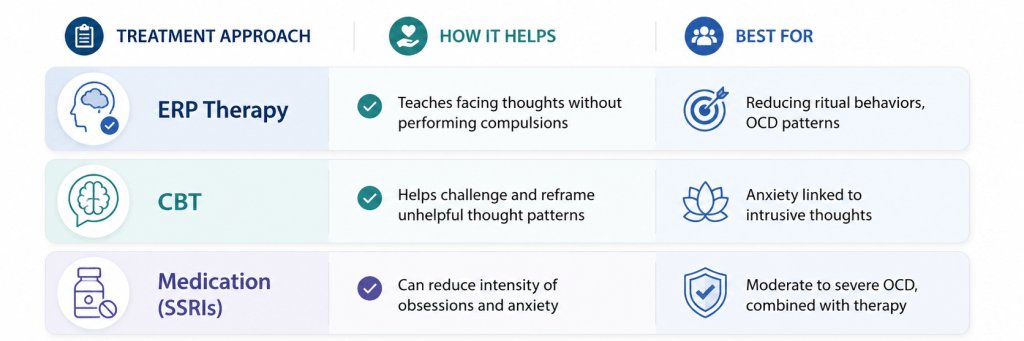
Both intrusive thoughts and OCD respond well to structured, evidence-based care. Treatment focuses on breaking the cycle of fear and compulsion. It also builds resilience for long-term wellness.
| Treatment Approach | How It Helps | Best For |
| ERP Therapy | Teaches facing thoughts without performing compulsions | Reducing ritual behaviors, OCD patterns |
| CBT | Helps challenge and reframe unhelpful thought patterns | Anxiety linked to intrusive thoughts |
| Medication (SSRIs) | Can reduce intensity of obsessions and anxiety | Moderate to severe OCD, combined with therapy |
Recovery looks different for everyone. Some adults benefit from therapy alone. Others find medication helpful alongside counseling.
A specialist can help weigh therapy and medication choices based on your unique needs. Starting care feels more approachable with specialized Alpharetta care that understands your community.
How MD Psych Clinic Supports Your Mental Health Journey

At MD Psych Clinic, our board-certified psychiatrists specialize in personalized medication management and evidence-based care for OCD and anxiety. We combine compassionate evaluation with ongoing support to help you find the right treatment path for lasting relief.
What we offer:
- Comprehensive diagnostic assessments for OCD and related conditions
- Personalized medication management with careful monitoring
- Coordination with therapists for ERP and CBT in your care plan
- Flexible follow-ups (in-person or telehealth) for Georgia patients
📞 Ready to optimize your OCD treatment?
Call 770-680-2302 or Schedule a Consultation to speak with our team today.
📧 Email: paitent@mdpsychclinic.com
Hours: Monday–Friday, 8:00 AM – 5:00 PM
Location: 3235 North Point Parkway, Suite 203 Alpharetta, GA 30005
You don’t have to manage intrusive thoughts or OCD alone. Let’s build a plan that works for you
FAQs
Can you have intrusive thoughts without having OCD?
Yes. Intrusive thoughts are very common. Research shows about 94% of people experience them.
Having a strange or upsetting thought does not mean you have OCD. OCD involves a specific pattern: persistent obsessions plus compulsions that take significant time and cause impairment.
How do I know if my thoughts are part of OCD?
Notice your response to the thought. Do you feel driven to perform a ritual, seek reassurance, or avoid situations? Does the thought consume over an hour of your day?
These patterns, especially with distress or life disruption, may signal OCD. A professional evaluation can provide clarity.
What is the difference between anxiety thoughts and OCD thoughts?
Anxiety thoughts often focus on real-life worries, like work or health. OCD thoughts typically feel more irrational, intrusive, and “sticky.” They often involve themes of harm, contamination, or taboo topics. The key difference is the compulsive response OCD creates to neutralize the anxiety.
Are intrusive thoughts a sign of something serious?
Usually, no. Intrusive thoughts are a normal part of human cognition. They become a clinical concern only when they are frequent, cause high distress, and lead to time-consuming compulsions or avoidance. If this pattern sounds familiar, speaking with a specialist is a proactive step.
When should I seek help for intrusive thoughts or OCD?
Consider support if thoughts feel uncontrollable, cause significant shame or anxiety, or interfere with work, relationships, or daily tasks. You do not need to wait for a crisis. Early, evidence-based care can help you regain peace and function more fully.