


Some children seem distracted because their mind jumps from one thing to the next. Others seem distracted because worry keeps pulling their attention away.
That difference can be hard to see from the outside. A child with ADHD may avoid homework because starting feels difficult. A child with anxiety may avoid homework because they fear making mistakes.
Parents do not need to figure it out alone. Clear patterns, school feedback, sleep habits, and a professional evaluation can help show what is really going on.
Why ADHD and Anxiety Can Look Similar
ADHD and anxiety can both affect attention, emotions, sleep, schoolwork, and behavior. A child may seem restless, distracted, or upset in both cases.
The reason behind the behavior is often different. ADHD usually affects self-control, attention, and organization. Anxiety is more often driven by fear, worry, or a need to feel safe.
The CDC notes that ADHD symptoms may include inattention, hyperactivity, impulsivity, or a combination of these patterns. It also states that anxiety and sleep problems can look similar to ADHD, so diagnosis takes several steps.
| Shared Sign | Could Be ADHD | Could Be Anxiety |
| Trouble focusing | Mind shifts quickly | Worry pulls attention away |
| Avoiding tasks | Task feels boring or hard to start | Fear of failure feels overwhelming |
| Restlessness | Body seeks movement | Body reacts to worry |
| Irritability | Frustration builds quickly | Stress feels hard to manage |
| Sleep trouble | Hard to settle down | Worries increase at night |
Many children also have more than one concern. The CDC reports that about 4 in 10 children with ADHD also have anxiety, so symptoms can overlap in real life.
Key Differences Parents Can Watch For
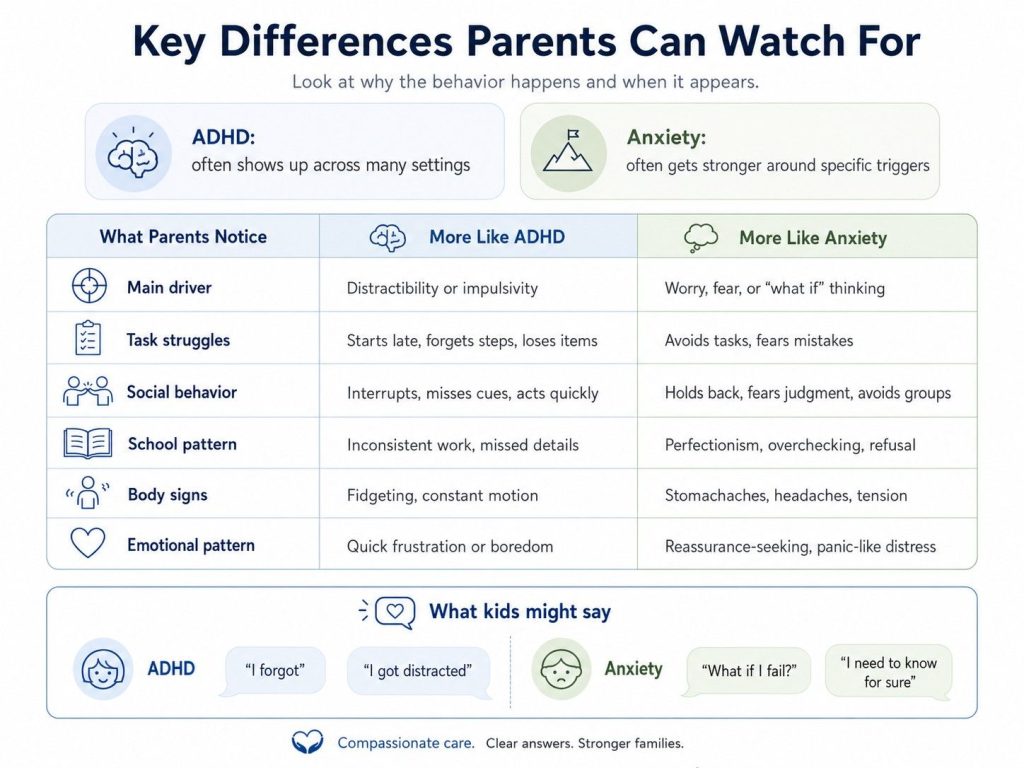
The biggest clue is not just what your child does. It is why the behavior happens and when it appears.
ADHD symptoms usually show up across many settings. A child may struggle at home, school, sports, and daily routines, even when they are not worried.
Anxiety may show up more strongly around certain triggers. These may include tests, separation, social events, bedtime, health worries, or new situations.
| What Parents Notice | More Like ADHD | More Like Anxiety |
| Main driver | Distractibility or impulsivity | Worry, fear, or “what if” thinking |
| Task struggles | Starts late, forgets steps, loses items | Avoids because mistakes feel scary |
| Social behavior | Interrupts, misses cues, acts quickly | Holds back, fears judgment, avoids groups |
| School pattern | Inconsistent work and missed details | Perfectionism, overchecking, or refusal |
| Body signs | Fidgeting, climbing, constant motion | Stomachaches, headaches, nausea, tension |
| Emotional pattern | Quick frustration and boredom | Reassurance seeking and panic-like distress |
A child with ADHD may say, “I forgot,” “I got distracted,” or “I do not know where to start.” These statements often point to planning and attention struggles.
A child with anxiety may say, “What if I fail?” “What if something bad happens?” or “I need to know for sure.” These statements often point to fear and uncertainty.
Questions That Help Parents Clarify the Pattern
Parents can learn a lot by looking for patterns over time. One difficult week does not always mean a disorder is present.
NIMH notes that children can be anxious, irritable, restless, or distracted at times. Concern increases when symptoms become persistent, intense, or disruptive.
Helpful questions include:
- Does the behavior happen in more than one setting?
- Does your child seem distracted even during calm moments?
- Does worry increase before certain events or transitions?
- Does your child avoid tasks because they feel boring or scary?
- Does reassurance help briefly, then need to be repeated?
- Do symptoms affect grades, friendships, sleep, or family routines?
| Parent Question | What It May Suggest |
| “Is my child forgetful even when calm?” | ADHD may be part of the picture |
| “Does worry appear before school or bedtime?” | Anxiety may be driving symptoms |
| “Does my child need repeated reassurance?” | Anxiety may be creating a safety loop |
| “Does my child interrupt or act without thinking?” | ADHD may be affecting impulse control |
| “Do symptoms worsen with poor sleep?” | Sleep should be reviewed carefully |
Sleep deserves special attention. Poor sleep can worsen focus, mood, and worry, while bedtime fears may point toward sleep-related anxiety that needs support.
When ADHD and Anxiety Happen Together

Some children have both ADHD and anxiety. This can make symptoms harder to understand because one condition can intensify the other.
For example, ADHD can cause missed assignments. Then anxiety may grow because the child feels behind, embarrassed, or afraid of getting in trouble.
Anxiety can also hide ADHD. A worried child may work very hard to stay organized, but feel exhausted from trying to keep everything under control.
| If Both Are Present | What Parents May See |
| Homework struggles | Avoidance, tears, forgotten steps, or perfectionism |
| School stress | Incomplete work plus fear of criticism |
| Social challenges | Interrupting at times, withdrawing at others |
| Emotional overload | Quick frustration followed by guilt or worry |
| Family routines | Repeated reminders, conflict, and reassurance seeking |
A full evaluation can help separate attention problems from worry patterns. Families seeking ADHD treatment support can benefit from a careful review of symptoms across home and school.
Parents may also notice similar patterns in themselves. ADHD and anxiety can appear across age groups, and adult symptom overlap may help some families understand shared challenges.
What Helps at Home, School, and Treatment
Support works best when it matches the reason behind the behavior. ADHD often needs structure and skill-building. Anxiety often needs coping tools and gradual confidence-building.
Children with ADHD may need help with routines, reminders, task steps, and movement breaks. Children with anxiety may need help naming fears, facing small challenges, and reducing reassurance loops.
| If the Main Concern Is | Helpful Support |
| ADHD | Visual routines, short steps, timers, movement breaks |
| Anxiety | Calm coaching, coping skills, gradual exposure, predictable plans |
| Both | Structure plus emotional support |
| Sleep problems | Consistent bedtime, lower screen use, anxiety review |
| School struggles | Teacher feedback, classroom supports, evaluation if needed |
At home, parents can try:
- Break homework into short steps
- Use one clear instruction at a time
- Praise effort, not only results
- Keep routines predictable
- Reduce repeated reassurance when possible
- Notice patterns before assuming defiance
- Ask teachers what they see during the school day
For children with ADHD traits, practical parenting strategies can reduce conflict and make routines easier. Small changes can help children feel more capable.
Professional support may be needed when symptoms interfere with school, friendships, sleep, or family life. Warning signs are often clearer when parents track child mental health signs over several weeks.
A professional evaluation may include:
- Parent and child interviews
- Teacher input or school forms
- Symptom rating scales
- Sleep and medical history review
- Screening for anxiety, ADHD, learning concerns, and mood symptoms
- A treatment plan based on the child’s needs
Treatment may include therapy, parent coaching, school support, medication, or a mix of services. The right plan depends on the child’s age, symptoms, strengths, and daily challenges.
How MD Psych Clinic Supports Your Child’s ADHD and Anxiety Journey

At MD Psych Clinic, our team helps families understand whether a child’s symptoms are more consistent with ADHD, anxiety, or both. We focus on clear answers, compassionate care, and practical next steps.
Our board-certified psychiatrists provide personalized evaluations and treatment planning for children and families. Care may include diagnostic clarification, medication management when appropriate, and coordination with therapy or school supports.
What we offer:
- Comprehensive child ADHD and anxiety evaluations
- Personalized treatment planning for each child
- Medication management with careful monitoring when needed
- Support for parents navigating school and home challenges
- Flexible follow-ups for Georgia families
Families can receive thoughtful child mental health care that looks at the full picture, not just one symptom.
Ready to better understand your child’s symptoms?
Call 770-680-2302 or Schedule a Consultation to speak with our team today.
Email: hello@mdpsychclinic.com
Hours: Monday–Friday, 8:00 AM – 5:00 PM
Location: 3235 North Point Parkway, Suite 203, Alpharetta, GA 30005
You do not have to sort through ADHD and anxiety alone. Let’s build a plan that helps your child feel supported, understood, and ready to grow.
Frequently Asked Questions
Can a child have both ADHD and anxiety?
Yes. Some children have both ADHD and anxiety, which can make symptoms harder to understand. ADHD may cause forgetfulness, impulsive behavior, or trouble finishing tasks, while anxiety may cause worry, avoidance, or repeated reassurance seeking.
A professional evaluation can help clarify what is driving your child’s behavior and what type of support may help most.
How can parents tell if poor focus is ADHD or anxiety?
Look at what happens before the focus problem begins. A child with ADHD may lose focus even when calm, interested, or trying hard. A child with anxiety may lose focus because worry, fear, or perfectionism takes over.
School feedback, sleep patterns, and behavior at home can help show whether the issue is attention, worry, or both.
When should I seek help for my child’s ADHD or anxiety symptoms?
Consider support if symptoms affect schoolwork, friendships, sleep, family routines, or your child’s confidence. You should also seek help if your child has frequent meltdowns, avoids normal activities, or feels overwhelmed by daily tasks.
You do not need to wait for a crisis. Early care can help your child build skills and reduce stress.
Does MD Psych Clinic evaluate children for ADHD and anxiety?
Yes. MD Psych Clinic provides child mental health evaluations to help families understand whether symptoms may be related to ADHD, anxiety, or another concern.
The team reviews your child’s symptoms, history, daily functioning, and family concerns to create a clear treatment plan.
Can MD Psych Clinic help with medication management for children?
Yes. When medication is appropriate, MD Psych Clinic offers careful medication management with ongoing monitoring. The goal is to support your child’s focus, emotional regulation, and daily functioning while watching for side effects.
Treatment may also include therapy referrals, parent support, and coordination with other care providers when needed.